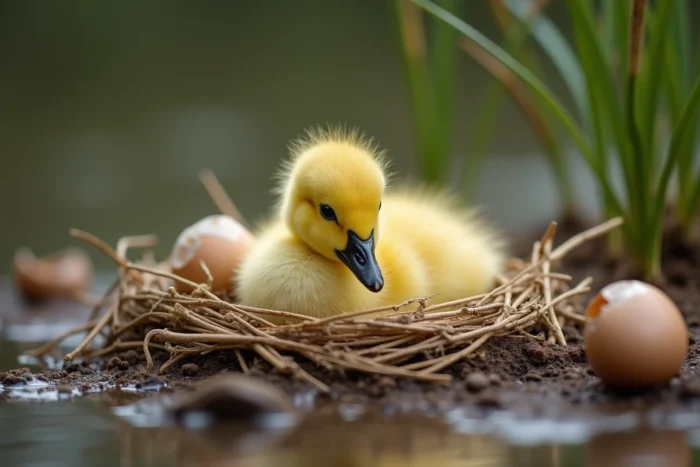
How long does it take for a gosling to transition from yellow down to the waterproof plumage of an adult goose, and what factors accelerate or slow down this transition? The answer varies depending on the breed, rearing conditions, and increasingly, the spring climate uncertainties. Understanding the life stages of the gosling helps anticipate nutritional, health, and environmental needs at each stage of development.
Comparative Duration of Development Stages by Goose Type
Not all geese grow at the same rate. Heavy breeds (Toulouse, Embden) and light breeds (Chinese goose, Landes goose) show notable differences in incubation duration, growth rate, and age of sexual maturity.
| Stage | Heavy Breeds | Light Breeds |
|---|---|---|
| Incubation | 30 to 32 days | 28 to 30 days |
| Neonatal Down | Weeks 1-3 | Weeks 1-2 |
| Appearance of Cover Feathers | Around the 4th week | Around the 3rd week |
| Complete Juvenile Plumage | 8 to 10 weeks | 6 to 8 weeks |
| First Complete Molt | Around 5-6 months | Around 4-5 months |
| Sexual Maturity | After the 1st year | End of the 1st year |
The gap between heavy and light breeds widens especially during the rapid growth phase, between the 3rd and 10th weeks. Heavy breeds mobilize more energy for body mass gain, which slightly delays plumage maturation.
To delve deeper into the life stages of the gosling and the chronological benchmarks of each stage, a week-by-week follow-up remains the most reliable method in rearing.
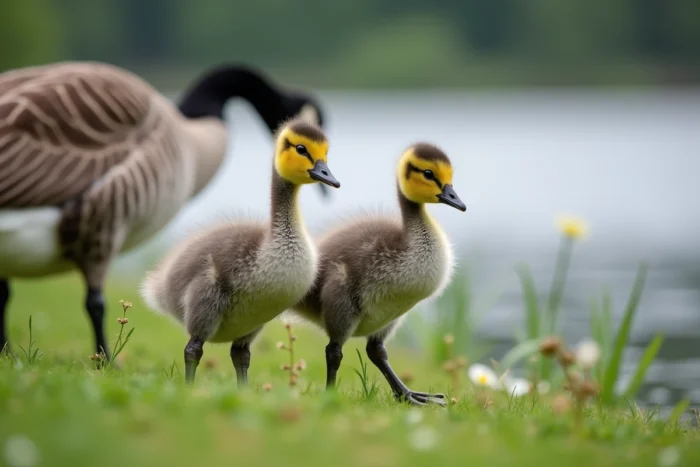
Hatching and Early Weeks: What Determines the Gosling’s Survival
Hatching mobilizes a temporary organ called the hatching tooth, a small keratinized growth on the top of the beak. It allows the gosling to break through the shell from the inside. This tooth disappears in the days following birth.
Upon exiting the egg, the gosling is covered in dense but poorly insulating down. Its thermoregulation remains immature during the first two weeks. Therefore, the ambient temperature of the rearing area must be maintained at a sufficiently high level, then gradually lowered.
Critical Factors During the Neonatal Phase
- Humidity during incubation must remain within a range of 55% to 75% to ensure optimal hatching rates and limit deformities.
- The imprinting phenomenon triggers in the first hours: the gosling attaches to the first moving being it perceives, whether it be the mother goose, a breeder, or a peer.
- Access to drinking water, but not yet to a deep pool, is essential from the first day to prevent rapid dehydration.
- The density of the group in the rearing space directly influences stress and growth: too confined a space causes pecking among goslings.
A poorly imprinted gosling develops lasting anxious behaviors that hinder its socialization within the group once it reaches adulthood.
Juvenile Growth and Molt: The Transition to Adult Plumage
Between the 3rd and 10th weeks, the gosling enters a phase of accelerated growth. The down gives way to cover feathers, first on the sides and back, then on the wings. The juvenile plumage does not yet provide complete waterproofing, which limits prolonged access to water in open environments.
The first complete molt occurs several months after hatching. It replaces the juvenile plumage with adult plumage, which is denser and features the barbule-hook structure that ensures waterproofing. This molt often coincides with a temporary decrease in weight gain, as the body redirects a significant portion of its resources toward keratin synthesis.
Feeding During Growth
The protein needs of the gosling decrease over the weeks. In the neonatal phase, a high-protein starter feed is recommended. From the 4th week, the ration evolves towards a mix richer in fiber, incorporating grass and fresh vegetation.
Grass becomes the main dietary base for the goose from the juvenile stage. Geese are among the few poultry capable of efficiently digesting cellulose due to the length of their digestive tract.
Climate Change and Goslings: Early Hatchings and Spring Heatwaves
Breeders and ornithologists have observed in recent years a shift in laying and hatching dates among several species of geese, both wild and domestic. Milder springs trigger earlier laying in the season.
This shift creates a synchronization problem. Goslings hatch before the spring plant resources (young shoots rich in protein) reach their peak availability. A delay of just a few days between hatching and peak vegetation is enough to reduce the survival of wild goslings.
Vulnerability to Heat Episodes
Spring heatwaves pose an additional risk. The gosling, whose thermoregulation is immature during the first weeks, struggles with temperature spikes. In rearing, shading and misting devices partially compensate for this thermal stress. In natural environments, exposed nests experience increased mortality.
In contrast, goslings born in cooler conditions develop slightly denser down, giving them a thermal advantage during the cold nights of early spring. The gradual warming of average temperatures tends to reduce this advantage without eliminating the risk of late frosts.
Sexual Maturity and Transition to Adulthood in Geese
The goose reaches sexual maturity by the end of its first year for light breeds, sometimes beyond for heavy breeds. This stage is characterized by behavioral changes: the gander becomes territorial, and the goose begins to seek a nesting site.
The lifespan of the domestic goose can reach eight years, making it one of the most durable poultry. Fertility remains stable over several breeding seasons before gradually declining.
The transition from juvenile to adult stage is not limited to plumage. The skeletal structure continues to consolidate for several months after the appearance of the definitive plumage. An individual that appears visually adult may still be in the skeletal maturation phase, making abrupt handling risky for young geese under one year old.
The distinction between a physiologically mature animal and one that is simply in adult plumage is often an underestimated point in amateur rearing. A careful monitoring of body development, beyond the sole visual criterion of plumage, remains the best indicator for adapting feeding and living conditions at each stage.