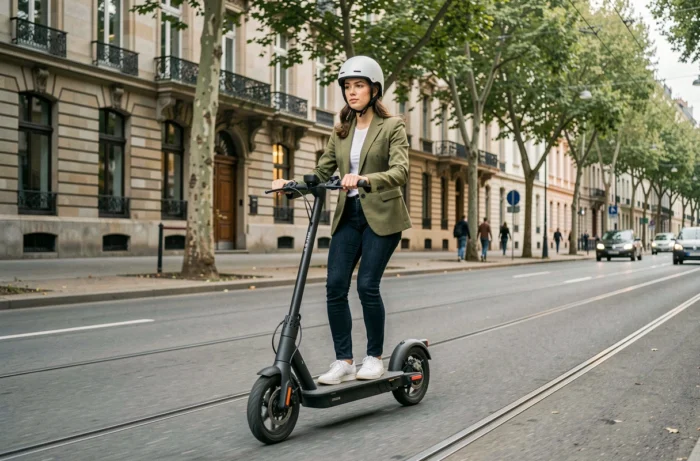
Getting around the city on an electric scooter is primarily a sensation: no vibration at startup, no engine noise at a red light, and a strong acceleration from the very first second. Urban electric mobility is not just an ecological gesture. It concretely changes the way we move, park, and budget for our daily trips.
Regulatory category of the electric scooter: the criterion that product sheets overlook
Before comparing range or power, the first question to ask concerns the administrative category of the vehicle. An electric scooter equivalent to 50 cm³ (category L1e) can be driven from the age of 14 with an AM license. A model equivalent to 125 cm³ (category L3e) requires an A1 license or a seven-hour training course for holders of a B license.
Why is this point so crucial? Because the category determines the maximum allowed speed, the type of road accessible, and the equipment obligations. An L1e scooter does not exceed 45 km/h, which is sufficient for a dense city center but becomes limiting on a suburban expressway.
L3e models generally go up to 80 km/h, sometimes more. They allow access to ring roads and bypasses in certain urban areas. Choosing the wrong category is like buying a vehicle unsuitable for your actual journey, which results either in daily frustration or unintentional violations. On speeder.fr, the sheets detail the regulatory category of each model, simplifying the sorting from the start.
Range and battery: understanding what really changes from one model to another
The range displayed by manufacturers corresponds to a theoretical use, often measured on flat terrain, at a constant speed, with an average-weight rider. In real conditions, variations are significant.
Factors that reduce range
- Terrain: a steady incline of a few percent can notably reduce range compared to a flat route
- Outside temperature: below 10 °C, the chemistry of lithium-ion cells slows down and the available capacity decreases
- Carried weight: a passenger or a loaded top case puts more demand on the motor with each acceleration
- Driving style: sharp and repeated accelerations consume more than anticipatory and steady driving
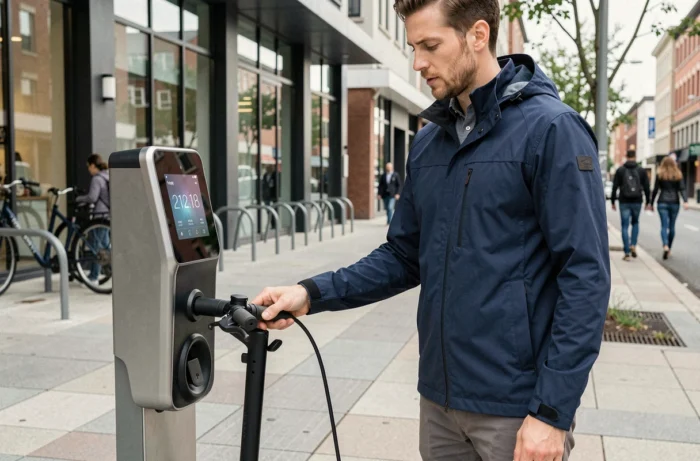
A point often overlooked concerns the type of battery. A removable battery can be charged from a standard household outlet, which avoids having to park the scooter near a charging station. For a city dweller without a garage, this is a considerable practical advantage: you take the battery upstairs at night and plug it in again in the morning.
Fixed batteries, which are bulkier, generally offer a higher capacity. The compromise depends on the daily distance and the possibilities for charging at home or work.
Real cost of an electric scooter in daily use
The purchase price of an electric scooter remains higher than that of a thermal equivalent. The difference is offset by two factors: energy and maintenance.
Energy: a charge for a few cents
The cost of a full charge represents a fraction of the price of a full tank of gas. Specifically, for daily use of a few dozen kilometers, the monthly electricity bill related to the scooter remains marginal compared to the fuel budget of a thermal model.
Maintenance: fewer wear parts
An electric motor has no clutch, no timing belt, and no oil filter. Brakes also wear out less quickly thanks to regenerative braking, which recovers energy during deceleration. Maintenance tasks are limited to tires, brake pads, and electrical checks.
This reduction in maintenance costs weighs heavily over time. After two or three years of daily use, the price difference at purchase begins to diminish.
Parking and ZFE: real advantages but variable depending on the municipality
Electric scooters benefit from the Crit’Air 0 sticker, which guarantees them access to all low-emission zones (ZFE) established in major French urban areas. While an older thermal scooter may be banned from circulation on certain days, an electric model can move freely.
You might think that the Crit’Air 0 sticker also grants access to free parking? Parking regulations are set by each municipality, regardless of the Crit’Air classification. Some cities offer free parking, while others do not. It’s essential to check local regulations before assuming this advantage is guaranteed.
Local regulations are becoming an increasingly determining factor. According to Le Monde (September 2026), the conditions for using an electric vehicle can vary significantly from one area to another, beyond the national framework. Helmet, high-visibility vest, speed limits in certain zones: obligations are multiplying and differ by department.
Recent innovations in electric scooters: connectivity and safety
Recent models incorporate features that did not exist on entry-level thermal scooters. A connected dashboard allows tracking of battery status, real-time consumption, and sometimes the vehicle’s GPS location via a mobile app.
- Adjustable regenerative braking, which allows for energy recovery to be tailored to the driver’s preferences
- Driving modes (eco, normal, sport) that modify the torque curve and remaining range
- Geolocation and anti-theft alert, useful in an urban context where two-wheeled theft remains frequent
These connected features transform the scooter into a communicating object, capable of signaling a technical anomaly before it becomes a breakdown. For a vehicle used daily, this anticipation reduces unexpected immobilizations.
The electric scooter market continues to grow, but this growth heavily depends on available public subsidies. According to data from PW Consulting (2026, citing ACEM), demand does not evolve uniformly: areas where subsidies are generous record significantly higher sales. Choosing your electric scooter also means informing yourself about local and national grants in effect at the time of purchase, as they can significantly reduce the initial budget.