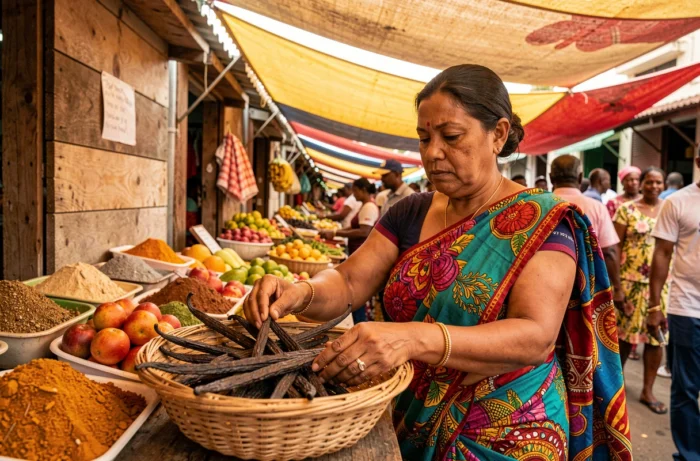
You bring vanilla pods back from Mauritius, expecting an exceptional product. But once you get home, they have no aroma at all. This scenario comes up often in travelers’ reviews. Buying vanilla in Mauritius takes a little know-how to avoid pods that have already been used or imported from elsewhere.
Spent pods and false origins: what to check before you buy
The best-documented pitfall at Mauritian markets involves pods that have already been used to make liquid vanilla extract. Travelers report seeing pods run between two rollers to extract their contents, then rehydrated to make them look shiny and supple again. The result: a pod that looks fine but has no aroma.
How can you spot this kind of product? Open the packet before paying. A quality pod gives off a strong, floral, slightly caramelized aroma as soon as you take it out of its packaging. If it is sold in sealed plastic with no way to smell it, that is a warning sign. A pod that has already been extracted is often flatter and drier to the touch despite looking damp on the surface, and may have regular linear marks (from pressing).
The other question is where the vanilla actually comes from. Madagascar vanilla dominates the global market, and some pods sold in Mauritius come from there. A reputable local producer will show you their plantation or explain their supply chain. They can describe the hand-pollination, scalding and curing process, which takes several months. A market vendor who simply offers packets with no traceability cannot guarantee their origin.
If you’re looking for where to buy vanilla in Mauritius with some basic guarantees, the main thing is to have direct access to the growing site or processing workshop.
Mauritian vanilla at the markets: what the price does (and doesn’t) tell you
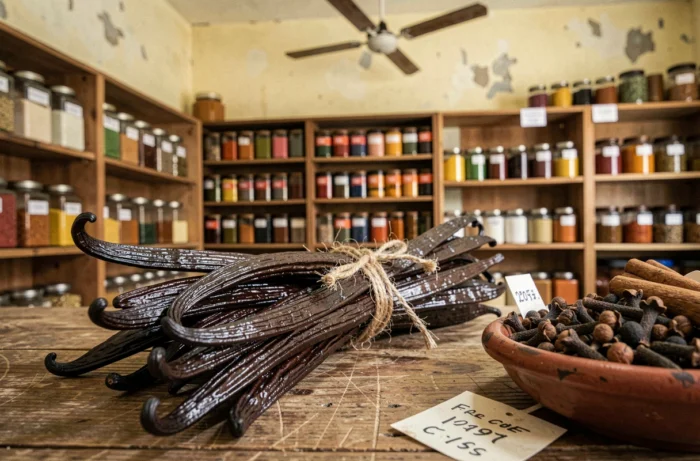
Local markets, especially the one in Port Louis, remain an almost essential stop for visitors. Vanilla is sold at a wide range of prices. A price that is unusually low compared with specialist shops may indicate lower-quality or previously processed pods.
Price alone is no guarantee of quality. An expensive pod on a tourist stall can be just as poor as a cheap one. What matters is being able to inspect the product:
- The pod should bend gently between your fingers without snapping or crumbling
- The surface should be naturally slightly oily and shiny, not wet as if it had recently been soaked
- The aroma should be noticeable from a few centimeters away, with sweet, rich notes—not just a musty smell
- The pod should be uniform in length and thickness, with no dried-out patches or white mold (not to be confused with vanillin frost, which looks like fine crystals)
Vanillin frost is a sign of quality, not a defect. These small white crystals appear naturally on well-cured pods. Be wary of any vendor who presents them as a problem or wipes them off.
Buying directly from a Mauritian producer: the most reliable option
Have you noticed that the best buying experiences tend to follow the same pattern? A place where you can see the plants, watch one stage of the process, and buy the finished product. It’s the only way to make sure the vanilla hasn’t passed through several middlemen.
Several farms in the south of the island offer this kind of visit. The process for making Mauritian Bourbon vanilla follows specific steps: harvesting green pods, scalding them in hot water, steaming, slow sun-drying, then curing in a trunk for several months. A producer who explains each stage and shows you their facilities offers a level of transparency that markets cannot provide.
Buying from the producer also lets you choose between different grades of pods. The plumpest and longest are intended for cooking, while thinner pods are suitable for making vanilla sugar or infused rum.
Vanilla-infused rum: a classic souvenir to bring home
Vanilla-infused rum is one of the most popular souvenirs in Mauritius. Here too, the quality of the pod makes all the difference. Vanilla-infused rum made with a spent pod will taste bland, even after several weeks of steeping.
If you buy a ready-made bottle, check that the pod inside is whole, split lengthwise, and still has visible seeds. A pod with no seeds in infused rum has probably already been used.
Specialist shops and cooperatives: a convenient middle ground
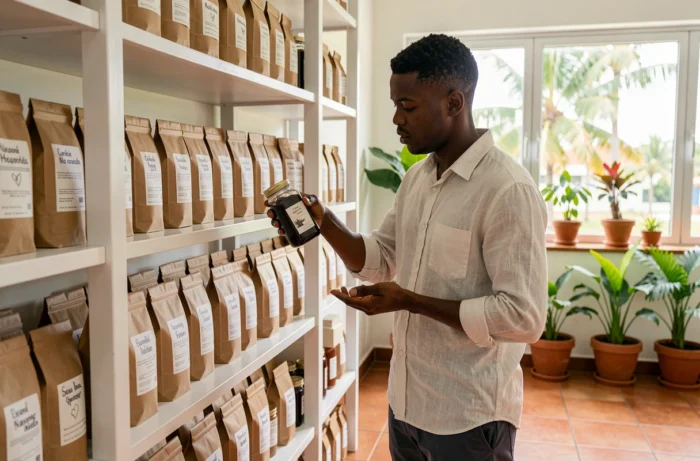
Between open-air markets and plantations, there are specialist shops and cooperatives that source vanilla from identified local producers. These outlets often provide more detailed labeling, including the pod’s geographical origin and sometimes the harvest year.
A reputable shop stores its pods in glass tubes or airtight containers, away from light. Vanilla left in direct sunlight on a stall loses its aroma within a few days. This storage detail distinguishes a careful retailer from a simple tourist outlet.
These shops often round out their selection with vanilla products such as liquid extract, vanilla powder and vanilla sugar. For extract, check the ingredient list: a good extract contains only vanilla, alcohol and, sometimes, sugar. Artificial colors or flavorings in a product presented as artisanal are a bad sign.
Bringing home quality vanilla from Mauritius ultimately comes down to a few simple habits: smell before you pay, feel the pod to check its suppleness, and favor sellers whose supply chain can be verified. A well-chosen pod will flavor desserts for months, making the few extra minutes spent inspecting it worthwhile.