At 8 months, the infant’s central nervous system reaches a stage where synaptic connections related to motor coordination multiply at a sustained pace. Voluntary motor patterns (pincer grasp, transition from sitting to crawling, standing with support) directly depend on the quality and frequency of the sensorimotor stimuli provided on the ground. Understanding which neuromotor mechanisms are truly at play helps in selecting the right activities.
Floor playtime and motor skills acquisition at 8 months
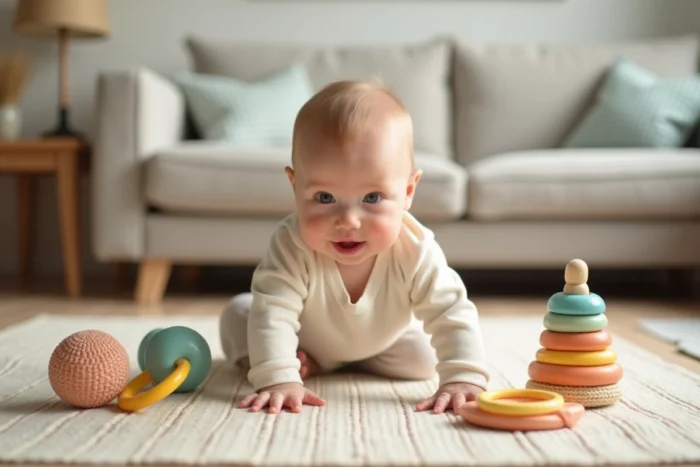
The time spent on the stomach on the floor remains the most underestimated lever at this age. A systematic review published by Hewitt et al. in Pediatrics (2020, University of Newcastle, Australia) showed that regular tummy time is associated with better gross motor performance: head control, rolling, crawling. Scores on motor development tests during the first year improve proportionally to the frequency of these sessions.
However, many families reduce tummy time once the baby can sit up. This is a mistake. At 8 months, the prone position engages the trunk extensors and scapular muscles necessary for transitioning to crawling.
To delve deeper into the topic of motor skills and baby development at 8 months, it is essential to first ensure this postural foundation. Without this stimulation, crawling can turn into scooting on the bottom, which is less beneficial for cross-lateral coordination of arms and legs.
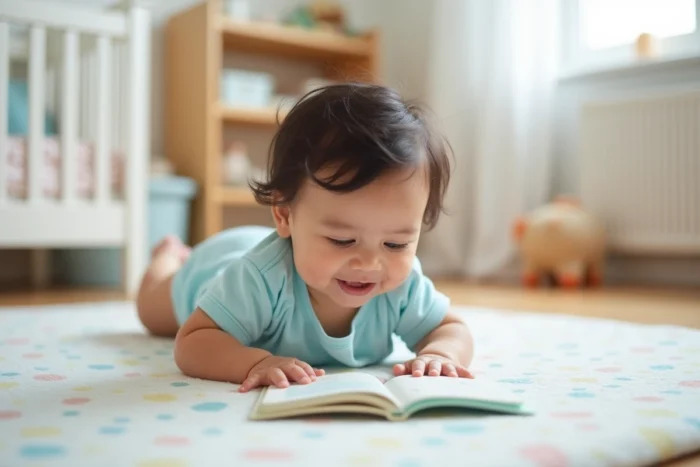
Specifically, we recommend maintaining several short sequences on the stomach each day, placing motivating objects (blocks, rings, textured balls) just out of reach. The baby must exert effort to reach them, which activates the deep muscle chains.
Fine motor activities for an 8-month-old baby
The pincer grasp begins to refine around the eighth month. This is not an automatic skill: fine motor grasping depends on the maturation of the corticospinal tract and repeated practice of grasping small objects.
“Pull and release” type games provide excellent support. Offering a ribbon attached to a lightweight toy forces the baby to adjust the pulling force and voluntarily release the grip, two skills that prepare for the eye-hand coordination necessary for self-feeding.
Three types of manipulation to prioritize at this age:
- Transferring an object from one hand to the other, by offering a second toy when the first hand is already occupied, to encourage voluntary release
- Exploring containers (open boxes, stacking cups) where the baby slides and removes small objects, working on finger dissociation
- Manipulating various textures (crumpled fabric, spiky ball, smooth wooden ring) which refines digital proprioception and pressure modulation
Background screens and infant motor skills
An active screen in the room reduces active floor playtime, even when the baby is not directly watching it. The WHO guidelines published in 2019 are explicit: children under one year should never be placed in front of a screen. Passive screen time replaces minutes of tummy time, rolling, and crawling.
The mechanism is simple. Audiovisual stimulation intermittently captures the baby’s attention, interrupting spontaneous motor sequences. An infant preparing to crawl towards an object may abandon their effort if a sound or light change distracts them. Over an entire day, these cumulative micro-interruptions represent a significant loss of motor practice.
We recommend turning off all screens during active wake periods. If an adult wishes to watch a program, doing so during the baby’s sleep phases remains the most realistic solution.
Playful activities targeting coordination and balance at 8 months
Dynamic sitting balance is built through controlled imbalances. Placing the baby sitting on a slightly unstable cushion (such as a folded nursing pillow) requires them to recruit their trunk stabilizing muscles. This type of gentle imbalance prepares for standing with support.

Some motor situations to integrate into the daily routine:
- The game of rolling a ball on the floor, where the sitting baby must pivot their trunk to follow the trajectory, working on segmental rotation
- The sensory path with different surfaces (carpet, tiles, thick blanket) that alters supports and balance responses during crawling
- Assisted sitting up, by offering fingers for the baby to pull on and transition from lying down to sitting, strengthening the abdominals and hip flexors
These activities require no specialized equipment. What matters is the daily repetition in a clear and safe environment.
Adapting difficulty to the baby’s pace
An 8-month-old baby who is not yet crawling is not behind. The developmental window for crawling extends over several months. Forcing a stage that the neuromotor system has not yet reached generates frustration without benefit. We always adjust the proposal to what the baby already knows how to do, adding only one complexity parameter at a time: slightly greater distance, a bit more unstable surface, a slightly smaller object.
The signal to observe remains the quality of the movement rather than its precocity. A well-coordinated crawl in a cross-lateral pattern is better than an early but asymmetrical crawl. If persistent asymmetry appears in movements or grasping, a psychomotor assessment allows checking that no underlying difficulties are hindering acquisitions.