Making liquid unit conversions can be a real headache when preparing a recipe. Between milliliters, liters, cups, and ounces, it’s easy to get lost. To avoid mistakes and save time, there are some simple tips.
Using a printed conversion chart displayed in the kitchen can be very handy. Many free mobile apps allow for quick unit conversions. Investing in measuring tools with clear markings in different units can make all the difference for stress-free cooking.
The essential basics for converting liquid units in the kitchen
In the world of cooking, precision is key. Recipes require exact liquid measurements to ensure the success of each preparation. Measure the ingredients correctly to guarantee a balance of flavors. The metric system, with its decimal logic, greatly facilitates these conversions.
Understanding measurement units
Milliliters and centiliters are commonly used volume measurement units. Here are some basic conversions:
- 1 liter = 100 centiliters
- 1 centiliter = 10 milliliters
- 200ml to l = 0.2 liter
These simple conversions are made possible by the decimal system, which uses powers of 10.
Essential tools
To convert liquid units accurately, use appropriate tools:
- Measuring cup: allows for precise volume measurements
- Conversion chart: serves as a quick reference
- Digital scale: program it for weight-to-volume conversions
These tools greatly simplify the conversion process, making cooking easier and more precise. A conversion error can alter the taste and texture of dishes, highlighting the importance of having reliable equivalents on hand. The density of liquids like water and oil varies, requiring adjustments in conversions. For example, 1 gram of water equals 1 milliliter, but this is not the case for oil or milk. Follow these essential basics to navigate liquid volume conversions in the kitchen with ease. 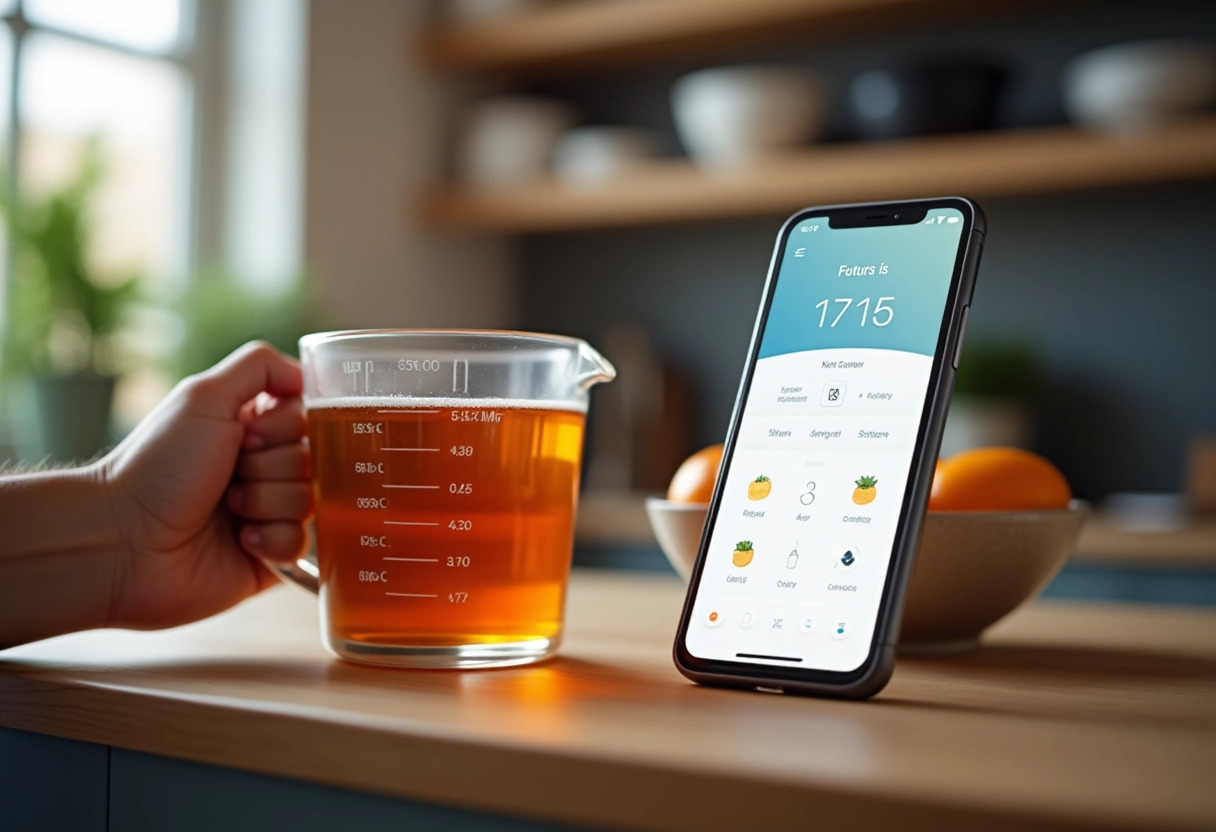
Tools and tips for accurate and easy liquid conversions
Converting liquids in the kitchen requires appropriate tools to ensure measurement accuracy:
- Measuring cup: a transparent measuring tool, often made of glass or plastic, with clear graduations for milliliters and centiliters.
- Graduated jug: ideal for measuring larger quantities of liquids. It offers similar precision to the measuring cup.
- Teaspoon and tablespoon: these common kitchen utensils allow for measuring small amounts of liquid. A teaspoon holds about 5 milliliters, while a tablespoon holds about 15.
- Digital scale: some models allow for automatic conversion of weight to volume, which is particularly useful for liquids with a density different from that of water.
For quick conversions, use a conversion chart. This type of chart allows you to quickly find equivalents between milliliters and centiliters, or between milliliters and liters. For example, 100 milliliters equals 10 centiliters.
Tips to avoid mistakes
Converting liquids like oil or milk requires special attention due to their density differing from that of water. Use precise measuring tools like a graduated cylinder or even a syringe for small quantities. These instruments offer increased accuracy, essential for delicate recipes. A specialized calculator can also be an asset for complex conversions. These digital tools are programmed to convert volume measurement units accurately, eliminating approximations and reducing the risk of conversion errors.